

5 Common Myths About In-Store Retail Media Networks
Myth #5

BlueZoo Logo

Bill Evans, BlueZoo CEO
BlueZoo debunks five common retail media myths and highlights the value of audience measurement
As retail media continues to evolve, transparent and reliable audience measurement remains an important part of building advertiser confidence and supporting the long-term growth of in-store media.”
MENLO PARK, CA, UNITED STATES, October 15, 2026 /EINPresswire.com/ -- Retail media networks (RMNs) are creating new opportunities for retailers to monetize their physical spaces and for brands to connect with shoppers closer to the point of purchase. As in-store media continues to grow, however, misconceptions about campaign measurement, infrastructure costs, and advertising effectiveness can limit how retailers and advertisers build their networks.— Bill Evans, CEO, BlueZoo Inc.
BlueZoo recently posted a five-part LinkedIn series examining common myths about in-store retail media networks. From the value of upper-funnel advertising to the role of audience measurement and screen placement, here are five misconceptions worth reconsidering.
Myth #1: Sales Are the Only Way to Measure Campaign Success
Sales will always be one of the most important metrics for evaluating advertising performance, but they do not tell the entire story. Like other advertising channels, in-store retail media can deliver value earlier in the customer journey, before a purchase occurs.
Metrics such as impressions, dwell time, unique visitors, and audience engagement help advertisers understand campaign exposure and performance beyond immediate sales outcomes. These insights can help brands evaluate awareness campaigns, understand how shoppers encounter their messaging, and assess in-store media as part of a broader omnichannel strategy.
Myth #2: Audience Measurement Is Too Expensive
The perceived cost of measurement can be a barrier for retailers considering an in-store retail media network. However, audience measurement does not necessarily require substantial capital expenditure and can represent a relatively small portion of a network's overall operating costs.
Reliable measurement helps retailers demonstrate campaign performance, optimize advertising inventory, refine pricing, and give advertisers greater confidence in the value of their investment. Without a clear understanding of the audiences their media reaches, retailers may struggle to communicate the value of their inventory or justify advertising rates.
Myth #3: In-Store Retail Media Can't Be Measured Like Online Advertising
Many advertisers assume that because in-store advertising takes place in a physical environment its performance cannot be evaluated with the same level of accountability they expect from digital channels. Although the measurement methods differ, modern technologies can provide meaningful insights into audience exposure and campaign performance in physical spaces.
By measuring the audience exposed to an advertisement and connecting exposure data with purchase behavior at checkout, retailers can evaluate campaign effectiveness using real-world shopper data rather than assumptions alone. This approach helps establish a clearer relationship between media delivery and business outcomes.
The distinction is important: understanding that an advertisement was played on a screen is not the same as understanding that an audience had an opportunity to see it. Measuring audience exposure provides an important foundation for evaluating campaign delivery, while connecting exposure with purchase data can offer further insight into outcomes.
Myth #4: Building an In-Store Retail Media Network Requires Significant Upfront Investment
The cost of launching an in-store retail media network can seem prohibitive, particularly when retailers assume they must invest in entirely new infrastructure before generating advertising revenue. In practice, deployment models offer greater flexibility than this assumption suggests.
Retailers can leverage existing infrastructure and expand their networks incrementally rather than investing in a complete new deployment all at once. Hardware-as-a-Service (HaaS) programs offer another approach, allowing retailers to deploy and scale digital infrastructure without the same level of upfront capital expenditure. Depending on the business model and how the network is commercialized, these approaches can help retailers manage costs and, in some cases, achieve positive cash flow from the outset.
A phased approach can also give retailers an opportunity to test media offerings, establish advertiser demand, and learn which locations and formats provide the greatest value before expanding further.
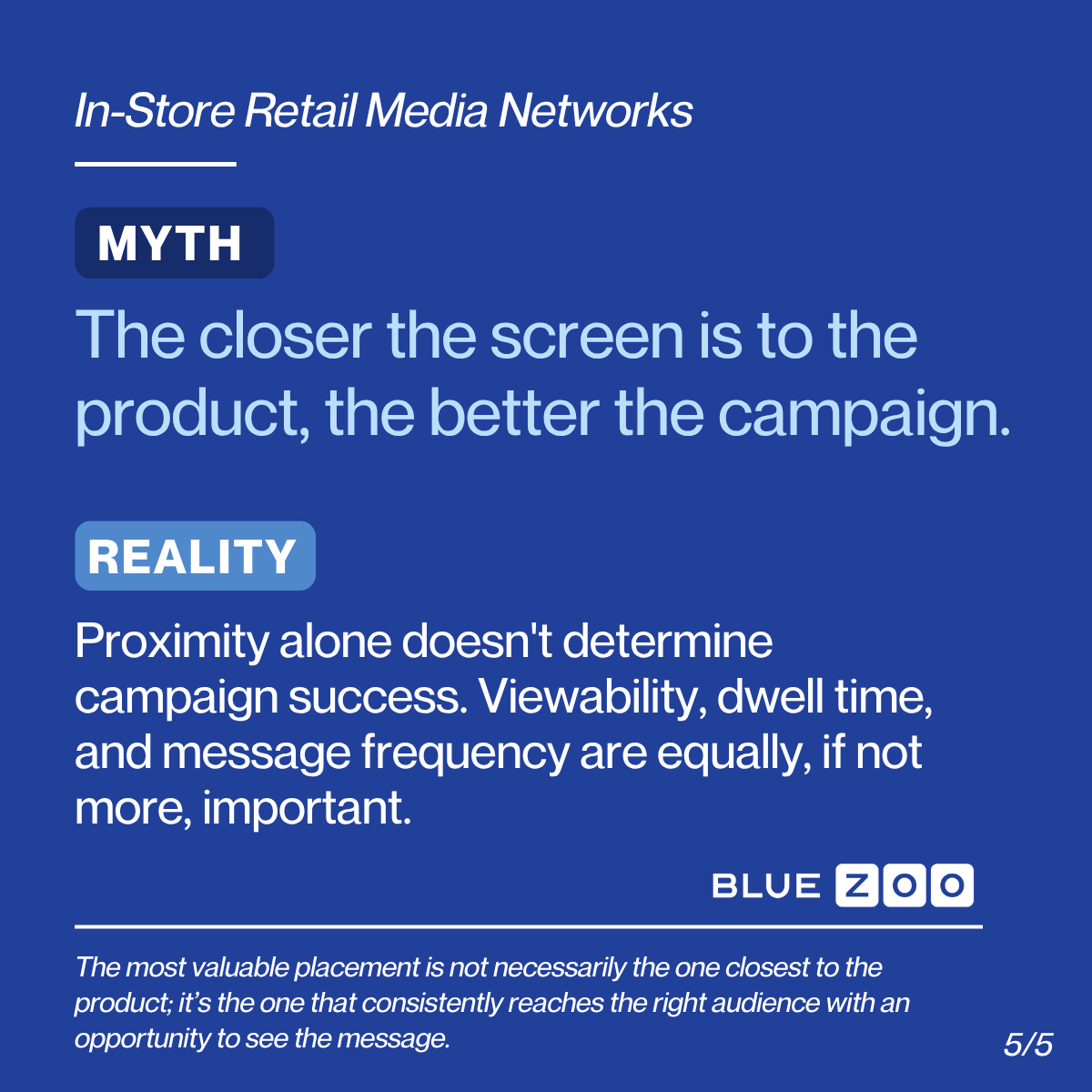
Myth #5: Proximity to the Product Is the Only Thing That Matters
Placing a digital screen next to a product does not automatically make it an effective advertising placement. Proximity can influence purchasing decisions, but the value of an in-store media placement depends on several factors, including whether shoppers have an opportunity to see the message, how long they remain in the area, how often they encounter it, and how the placement fits into their journey through the store.
A screen positioned slightly farther from a shelf but consistently reaching shoppers may deliver more value than one placed directly beside the product without comparable audience exposure. The effectiveness of a placement depends not only on its physical location but also on the audience behavior associated with that location. Understanding impressions, dwell time, reach, and audience patterns helps retailers evaluate how different placements perform rather than relying on proximity alone.
Looking Beyond the Myths
Building a successful in-store retail media network requires more than installing screens and selling advertising space. Retailers must consider how their networks are deployed, how media inventory is valued, and how campaign performance is measured and communicated to advertisers.
Across all five misconceptions, one theme stands out: understanding audience behavior is essential to understanding media value. Sales data remains important, but impressions, dwell time, unique visitors, and other audience metrics provide additional context for evaluating campaign exposure and effectiveness. Measurement can also help retailers make more informed decisions about investment, inventory, and network expansion.
"As retail media continues to evolve, transparent and reliable audience measurement remains an important part of building advertiser confidence and supporting the long-term growth of in-store media." says BlueZoo CEO, Bill Evans.
BlueZoo provides privacy-first audience measurement for in-store retail media networks and other physical environments. Using patented passive Wi-Fi technology, complemented by Bluetooth Low Energy (BLE) detection, BlueZoo measures audience exposure and provides insights into impressions, dwell time, unique visitors, visitor recurrence, and traffic flow. By delivering auditable audience insights without collecting personally identifiable information, BlueZoo helps organizations make more informed decisions about media placement, campaign measurement, and the growth of their retail media networks.
Emily Elliott
BlueZoo, Inc.
+1 858-353-7149
Visit us on social media:
LinkedIn
Facebook
YouTube
X
Other
Legal Disclaimer:
EIN Presswire provides this news content "as is" without warranty of any kind. We do not accept any responsibility or liability for the accuracy, content, images, videos, licenses, completeness, legality, or reliability of the information contained in this article. If you have any complaints or copyright issues related to this article, kindly contact the author above.
